
Glass is a solid, non-crystalline substance that is often created by melting silica or other minerals at high temperatures and then fast cooling it to avoid crystallisation. It is distinguished by its transparency, hardness, and chemical and heat resistance. Glass has been used by humans for thousands of years. The first ones to manufacture glass were the ancient Egyptians at around 1500 BC. The range of conceivable uses for glass has broadened considerably since those times.
Glass is used a lot in constructing, packaging, electronics, transportation, art, and scientific equipment because of its unique properties. It is able to be produced in a range of hues, patterns, and forms to accommodate various needs. Moreover, there are various types of glass, including stained glass, lead glass, borosilicate glass, soda-lime glass, aluminosilicate glass, and silica glass.
What is Glass?
Glass refers to a solid material that is commonly used in a wide range of applications. This day-to-day glass is typically transparent, although it is able to be translucent or opaque. Glass is created by heating a mixture of silica (silicon dioxide), soda ash (sodium carbonate), and lime (calcium oxide) to a high temperature until it melts and then allowing it to cool and solidify.
Scientifically speaking, ‘glass’ refers to a group of materials with certain physical and chemical properties. The term glass in physics is used to characterise supercooled liquids. This means that, for example, a window glass sheet looks like a solid object but in reality, it is a very viscous liquid. Almost any liquid or gas is able to be quickly cooled to become a sort of glass. Metals have the potential to transform into “metallic glasses” while they are quickly solidifying. Other types of exotic glasses are amber, which occurs naturally, or some forms of man made polymers like acrylic.
Glass is a versatile material that is able to be shaped into many different forms and sizes. It is widely used in construction, such as for windows, doors, and skylights, as well as in the production of optical instruments like lenses and prisms. Glass is a popular choice for electronic devices, including computer screens and smartphone displays.
Glass is recognized for its hardness and durability, in addition to its adaptability and transparency, making it perfect for usage in a variety of sectors. Nonetheless, it is able to be fragile and prone to breaking under certain situations, so it must be handled with care and with suitable safety measures. Glass is a fantastic option for dependable construction material or high-quality optical equipment.
What are the Types of Glass?
Listed below are the types of glass.
- Stained glass: Stained glass is a decorative glass created by adding metallic salts to molten glass, which produces a range of colors and textures. It has been used for centuries in religious buildings and decorative art objects, often depicting religious or historical events. The work process involves drawing or designing a pattern, cutting the glass pieces to the desired shapes, and assembling them using lead strips to create the final design. Stained glass is able to be found in a variety of styles and designs, it is appreciated for its beauty and ability to diffuse light.
- Lead glass: Lead glass, known as crystal glass, is a type of glass that contains lead oxide. It has a high refractive index, which makes it highly reflective and gives it a brilliant sparkle. Lead glass is commonly used to make fine glassware, such as wine glasses, decanters, and vases, as well as decorative objects like chandeliers and sculptures. However, it has to be mentioned that there is a certain health risk due to the lead oxide connected with this type of glass. It must actually not be used for food or beverage containers because the lead is able to leach into the food or beverage and then be ingested. Generally, lead glass is valued for its beauty and decorative qualities.
- Borosilicate glass: Borosilicate glass is a type of glass that contains boron oxide. It is known for its high heat resistance and durability and is commonly used in laboratory glassware, such as beakers, test tubes, and flasks, as well as in cookware like baking dishes and measuring cups. Borosilicate glass is applied in high-end lighting fixtures and in some telescope lenses. Overall, borosilicate glass is known for its strength and resistance to heat and chemical corrosion.
- Soda-lime Glass: Soda-lime glass is a type of glass made from a mixture of silica (silicon dioxide), soda (sodium carbonate), and lime (calcium oxide). It is the most common type of glass and is used in a wide variety of applications, such as windows, bottles, jars, light bulbs, and many other household and industrial items. The mixture of silica, soda, and lime is melted at high temperatures (usually over 1500°C) until it becomes a liquid. The liquid glass is then poured or blown into molds or shaped by other methods. Soda-lime glass is known for its low cost, high chemical durability, and good optical properties. It is able to be made in a range of colors by adding various metal oxides to the mixture, and it is able to be tempered to increase its strength. However, soda-lime glass is not as resistant to thermal shock and chemical corrosion as some other types of glass, and it is able to crack or break if exposed to rapid temperature changes.
- Aluminosilicate Glass: Aluminosilicate glass is a type of glass that is made primarily from silica (SiO2) and alumina (Al2O3). It is a type of high-performance glass that is designed to be strong, durable, and resistant to both thermal and mechanical stress.
It is formed by melting a mixture of alumina and silica at high temperatures, typically around 1700-2000°C. The resulting glass has a high degree of chemical and thermal stability, making it an ideal material for a wide range of applications. Aluminosilicate glass is typically four to five times stronger than soda-lime glass. Aluminosilicate glass is very resistant to heat stress in addition to being strong. This indicates that it can endure abrupt temperature fluctuations without cracking or breaking. It is often used in applications including cookware, smartphone, tablet, electronic displays, and laboratory equipment because of its mechanical and thermal resilience. - Silica Glass: Silica glass, known as fused silica or quartz glass, is a type of glass that is made primarily from silicon dioxide (SiO2), which is a chemical compound found in natural quartz crystals. It is a high-purity, amorphous form of silica that is created by melting silica (usually in the form of sand) at extremely high temperatures and then cooling it rapidly to prevent crystallisation. Silica glass is known for its exceptional optical and thermal properties, as well as its resistance to high temperatures and chemical corrosion. It is commonly used in a variety of industrial and scientific applications, such as optics, semiconductors, solar cells, and laboratory equipment. Silica glass is used in the manufacturing of high-quality lenses, mirrors, and prisms due to its ability to transmit light with very little distortion or scattering. One of the unique properties of silica glass is that it has a very low coefficient of thermal expansion, which means that it does not expand or contract significantly with changes in temperature. This makes it an ideal material for use in high-temperature applications, such as furnace tubes, as well as for precision optical components that require stability over a wide range of temperatures.
What are the Uses of Glass?
Glass is a flexible substance with several uses in daily life and numerous industries. Construction is one of the industries where glass is most often used. Construction often includes glass windows, doors, and skylights to let in natural light and provide a good perspective of the outside world. Commercial buildings are able to be made to seem sleek and contemporary by using glass facades, and their interiors are able to be made to look beautiful by using glass tiles and walls.
Glass is used in the packaging sector as well, where it is used to carry and store goods including food, drinks, and medications. Glass containers are popular because of their transparency, impermeability, and inertness, which help to keep the contents’ quality and freshness. Glass is used in the production of flat-screen TVs, computer monitors, and other display devices in the electronics sector. Glass substrates are utilized to support the electrical parts and provide an imaging-friendly flat surface.
Glass is utilized in the production of automotive windows, windshields, and other components in the transportation sector as well. Tempered glass is often used for safety reasons because it reduces the danger of damage when it breaks into tiny, spherical fragments. Glass is often used in the art and design business to make stained glass windows, sculptures, vases, and other decorative things. Glass’ special qualities, like its transparency, color, texture, and form, enable artists and designers to create complicated and beautiful pieces. Glass is used to make scientific apparatus, especially lab glassware like test tubes, beakers, and flasks. Glass is the perfect material for scientific applications where precision and consistency are crucial because of its strong resistance to chemicals, heat, and thermal stress.
There are not only a lot of different industries that use glass, or glass items but as well as a large number of glass manufacturers. Some of the world’s leading glass manufacturers include Saint-Gobain, AGC Inc., NSG Group, Corning Inc., Owens Corning, Nippon Sheet, Glass Co., Ltd., Guardian Industries Corp., Asahi Glass Co., Ltd., PPG Industries, Inc., and Schott AG.
Can I cut Glass?
Yes, glass can be cut with the right tools. The most common device for this job is a glass cutter. It is essentially a hard blade, which is used to scratch the glass on one side (or on both if the glass is particularly thick). Then pressure is applied to both sides of the scratch. Consequently, the glass sheet must crack evenly and with a straight edge. Make sure, however, to wear safety gloves and goggles when cutting glass. Those are needed to protect one’s eyes and hands from the sharp edges or glass splinters.
What can I use to cut Glass?
There are many ways to cut glass and different tools to do it. Each technique or device has its own advantages and limitations. Some common ways to cut glass include a glass cutter, glass cutting machine, waterjet cutter, laser cutter, and glass saw.
A glass cutter is a hand-held tool with a small, sharp cutting wheel that is used to score the surface of the glass along a straight line. The glass is then broken along this line. Glass cutters are simple, inexpensive, and are able to be used for cutting shapes or curves in addition to straight lines.
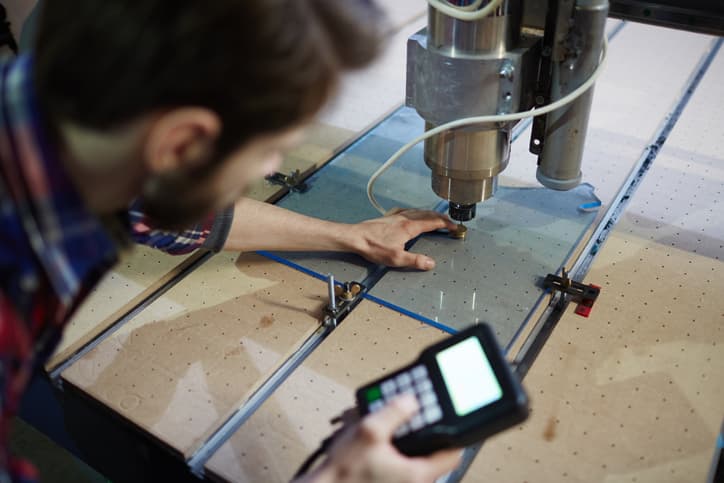
A glass cutting machine is a motorized machine that uses a diamond or carbide cutting wheel to score and cut glass. These machines are able to be either handheld or stationary and are often used in industrial applications for the precision cutting of large pieces of glass.
A Waterjet cutter is a high-tech machine that uses a powerful stream of water mixed with an abrasive material to cut through glass. Waterjet cutting is precise and is able to be used to cut intricate shapes and designs, but it is expensive.
The laser cutter is high-tech equipment that uses a laser to cut through glass. Laser cutting is precise and is able to be used to cut complex shapes and designs, but it requires specialized training to operate.
A glass saw is a powerful tool with a diamond-coated blade that is able to be used to cut curves and irregular shapes in glass. Glass saws are versatile and are able to be used to cut a wide range of glass types, but they are able to be expensive and require some skill to use effectively.
What Type of Laser Cutter can cut Glass?
It is important to note that not all lasers can cut glass. Glass is highly reflective and brittle that requires a specific type of laser and processing to cut effectively. Thus, one needs a laser with the right wavelength (one that is well absorbed by the glass). The best option here is an infrared laser with a wavelength of 10.6 µm. Up to 80% of the laser light is able to be absorbed by the glass with the right adjustments. Furthermore, the laser must be pulsed in order to deliver high beam power to the glass surface in a short period of time.
Several types of laser cutting are capable of cutting glass, including CO2 lasers, fiber lasers, and neodymium-doped yttrium aluminum garnet (Nd:YAG) lasers. There are benefits and drawbacks to each kind of laser cutter when it comes to cutting glass.
The most prevalent kind of laser cutters is CO2 lasers, which are excellent for cutting non-metallic materials including plastics, wood, paper, and textiles. Glass that is thicker than a sheet of paper is able to be cut using CO2 lasers, although it is more difficult to do so.
On the other hand, fiber lasers are able to efficiently cut glass and are perfect for cutting reflective materials like metal. They are more adaptable and precise than CO2 lasers because they generate a powerful beam that is transmitted over a flexible optical cable.
Glass is able to be cut using Nd:YAG lasers, which are able to make excellent cuts in a variety of materials. They are often used for the precise drilling and cutting of semiconductors, ceramics, and metals.
Fiber lasers are often regarded as the most efficient for cutting glass owing to their great accuracy and adaptability. They make clean, accurate cuts with little chipping or splitting and are able to cut through thicker glass than CO2 lasers.
Laser cutters are able to be used with glass for purposes other than cutting, such as laser engraving and branding. Laser marking entails applying text, pictures, or patterns to the glass’ surface using a laser to etch or engrave them. Wine glasses, mirrors, and trophies are just a few examples of ornamental or practical glass products that are often made using this method. On the other hand, laser engraving entails using a laser to remove a layer of material from the glass’ surface in order to produce a durable, high-contrast pattern. Personalized gifts, signs, and promotional objects often employ this method.
What are some Tips for Laser Cutting Glass?
Listed below are some tips for laser cutting glass.
- Choose the right type of laser: A femtosecond CO2 laser is the best option for the glass-cutting needs.
- Use high-quality glass: The quality of the glass impacts the quality of the cut. Choose a high-quality glass that is free from defects and impurities.
- Use a low-power setting: Glass is a brittle material that is able to crack or shatter if exposed to too much heat. Use a low-power setting to avoid overheating the glass and causing it to break.
- Use a focusing lens: A focusing lens are able to help to concentrate the laser beam and achieve a more precise cut. Make sure to use the appropriate lens for the thickness of the glass being cut.
- Apply a coolant: Glass is able to crack or shatter if exposed to rapid temperature changes. Applying a coolant, such as water or air, is able to help to dissipate heat and prevent thermal shock.
- Test and optimize: Laser cutting glass is able to be a challenging process, and is able to require some experimentation to achieve the desired result. Test the settings and make adjustments as needed to optimize the cutting process.
- Practice appropriate safety measures: Laser-cutting glass is able to produce hazardous fumes and dust, so make sure to use appropriate ventilation and safety equipment, such as a respirator, gloves, and goggles.
Keep in mind that laser cutting glass is able to be a complex process that requires specialized equipment and training. Seeking professional assistance and direction is bale to be beneficial to those who are new to laser cutting glass in order to guarantee a secure and efficient cutting procedure.
What is the Best Laser Cutting Machine for Glass?
The best laser-cutting machine for glass relies on a number of criteria, including the required cutting accuracy, cutting speed, as well as the glass’s thickness and kind. Some of the best glass laser-cutting machines are Trotec Speedy 360, Epilog Fusion Pro 48, and Kern Laser Systems HSE.
The Trotec Speedy 360 is a high-speed CO2 laser cutting machine capable of cutting through a variety of materials, including glass. It is able to cut glass up to 1/4 inch thick and has a maximum cutting speed of 170 inches per second. The equipment is equipped with a built-in camera for accurate positioning and Trotec’s proprietary software for simple and effective cutting. The Trotec Speedy 360 typically costs between $20,000 and $25,000. Its pros are fast cutting, accurate placement, and user-friendly software. However, glass has a restricted cutting thickness.
The CO2 laser cutting machine Epilog Fusion Pro 48 is perfect for cutting and engraving glass. It features a 48 by 36-inch cutting surface and a maximum cutting speed of 165 inches per second. The machine is equipped with a variety of attachments, including a rotary attachment for cutting and engraving cylindrical items, as well as Epilog’s sophisticated motion control system for high-precision cutting. The typical price range for the Epilog Fusion Pro 48 is between $35,000 and $45,000. Wide cutting surfaces, great accuracy, and rotating attachments for cylindrical items are all advantages. However, it is expensive.
The Kern Laser Systems HSE is a premium laser-cutting machine intended for the precise cutting of a variety of materials, including glass. It is equipped with a 400-watt fiber laser and is able to cut glass up to one inch thick. The machine has a cutting speed of up to 4,000 inches per minute and a variety of innovative functions, including automated focussing and a database of available materials. The typical price range for the Kern Laser Systems HSE is between $150,000 and $200,000. Excellent accuracy and cutting speed, and extensive features are its advantages. However, it is extremely pricey.
Overall, the Trotec Speedy 360, the Epilog Fusion Pro 48, and the Kern Laser Systems HSE are three of the best laser cutting machines for glass. Each has its own pros and cons. The Trotec Rapid 360 is suited for cutting thin glass at fast speeds, whereas the Epilog Fusion Pro 48 has a bigger cutting surface and rotating attachment for cylindrical shapes. The most costly laser system from Kern Laser Systems, the HSE is also the most precise and sophisticated.
How to Laser-Cut Glass?
Cutting glass with a laser is, in principle, a precise and efficient process. However, it requires specific equipment and safety precautions. Here are the general steps for cutting glass with a laser:
- Choose the appropriate laser. Not all lasers are suitable for cutting glass. One is going to need a laser that has a high power output and a specific wavelength that is able to be absorbed by the glass. Oftentimes, the best option is a CO2 laser. Consult with a laser expert or manufacturer to ensure to have the right equipment.
- Prepare the glass. The glass needs to be cleaned and dried before cutting. Any oils or debris on the surface can interfere with the laser’s ability to cut.
- Create a template. Make a template of the pattern that wishes to be cut from the glass to guarantee accuracy. It is able to be accomplished by printing a design onto paper or by creating a digital template using computer software.
- Place the glass. Place the glass on the laser’s cutting bed and secure it in place using clamps or other fixtures. Make sure the glass is level and secure.
- Set the laser parameters. Adjust the laser’s power, speed, and other parameters based on the thickness of the glass and the desired cutting depth.
- Start the laser. Press the start button to begin the cutting process. The laser is going to follow the template and cut through the glass.
- Remove the glass. Carefully remove the glass from the cutting bed after the cutting is finished. Take caution since the glass is sharp.
It’s important to note that cutting glass with a laser is able to produce harmful fumes and particles. Make sure to have proper ventilation and wear appropriate personal protective equipment. Additionally, laser cutting is a skilled task that must only be done by trained professionals.
Are there problems encountered when Laser Cutting Glass?
Yes, there are some problems that are able to be encountered when laser cutting glass. However, most of these issues are able to be avoided, if certain safety measures are applied. Some of these problems include cracking, chipping, thermal stress, smoke and debris, and edge quality.
Overall, laser cutting glass is able to be a challenging process that requires careful attention to detail and specialized equipment. It is important to work with experienced professionals who have the expertise and equipment necessary to produce high-quality cuts with minimal risk of damage or injury.
Is Glass useable for Laser Cutting?
Yes, glass is useable for laser cutting, and it is a popular material for laser-cutting in various industries, including the automotive, aerospace, and electronics industries. However, it is brittle. Therefore, laser-cutting glass requires careful attention and specialized equipment to achieve precise cuts without damaging the material.
The type of glass that is best for laser cutting depends on the specific application and desired outcome. Generally, tempered or annealed glass is preferred, as it is more resistant to cracking and chipping during the cutting process. Other types of glass, such as laminated or coated glass, are able to require special precautions or techniques to avoid damage. It is critical to utilize a laser cutter with optimum power, speed, and focus settings to make high-quality laser cuts on glass.
The cutting process typically involves melting and vaporizing the glass, so it is crucial to control the temperature and avoid thermal stress that is able to cause cracking or warping. Additionally, the glass must be properly supported and positioned to prevent vibration or movement during the cutting process.
Overall, laser cutting is able to be an effective and precise method for cutting glass, but it requires specialized equipment and expertise to ensure the best results.