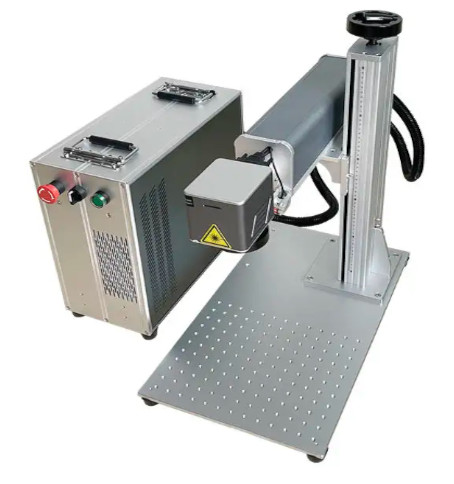
Nd:YAG and Nd:YVO4 are both solid-state lasers, meaning they both use a crystal as the laser-active material. In the case of Nd:YAG, it is a neodymium-doped yttrium aluminum garnet. This means the YAG crystal has neodymium atoms added to its crystal structure. In contrast, the Nd:YVO4 laser has neodymium atoms built into a yttrium orthovanadate (YVO4) crystal. These two lasers emit infrared light with a wavelength of 1.064 nm, thus creating nearly identical laser beams. Both types are diode-pumped solid-state (DPSS) lasers, meaning the laser light is generated by pumping a solid crystal with a laser diode. The laser diode, a light-emitting semiconductor similar to an LED, acts as a seed light source for the DPSS when an electrical current passes through it.
DPSS lasers offer many advantages, the most important being their high efficiency and the ability to be built in small sizes. Nd:YAG has an efficiency of up to 50%, while Nd:YVO4 can reach up to 60% under optimal conditions. These lasers are used in manufacturing, laser cutting, science, medicine, and the military, for applications such as laser rangefinders.
What is an Nd:YVO4 Laser?
An Nd:YVO4 laser is a lamp or diode-pumped solid-state laser where the active material is a crystal, unlike a gas laser like a CO2 laser. The primary component of this laser crystal is yttrium orthovanadate (YVO4) doped with neodymium atoms. Nd:YVO4 efficiently absorbs pumping power from diodes or flashlamps, with an absorption coefficient about five times higher than that of Nd:YAG. This high efficiency makes the yttrium orthovanadate laser one of the most efficient solid-state lasers on the market. Its higher absorption coefficient allows for smaller laser crystals, leading to a more compact laser setup. Moreover, Nd:YVO4 has a broader gain bandwidth than Nd:YAG, meaning a larger portion of the output radiation from the pumping diode can be utilized. This flexibility in the choice of pumping diodes makes Nd:YVO4 easier and cheaper to build than other solid-state lasers.
The lifetime of the higher laser states in Nd:YVO4 is shorter for moderate neodymium concentrations compared to Nd:YAG. The refractive index of Nd:YVO4 is around 2, while it is only 1.8 for Nd:YAG. Additionally, Nd:YVO4 has relatively high thermal conductivity, with 14 W/m/K, compared to about 9 W/m/K for Nd:YAG. This higher thermal conductivity makes Nd:YVO4 easier to cool. All these aspects make Nd:YVO4 a popular alternative to conventional Nd:YAG lasers.
Other solid-state laser materials include neodymium or ytterbium-doped glass or ruby. While there are many laser-active solids, these are the most commonly used.
What is a Nd:YAG Laser?
Nd:YAG stands for neodymium-doped yttrium aluminum garnet. It is a solid-state laser that can either be diode-pumped or flashlamp-pumped. It has become one of the most extensively used solid-state laser materials since its discovery at Bell Laboratories in 1964. Nd:YAG offers high laser gain at moderate excitation levels, can be pumped efficiently, and usually emits light with a 1064 nm wavelength. The selection of the pumping light source is critical for successful implementation due to its relatively limited gain bandwidth. The laser efficiency is not as high as for an Nd:YVO4 laser, but it is quite close. Nd:YAG lasers have become the workhorse in many fields, such as medicine, dentistry, biophysics, automotive manufacturing, and even the military. Several other laser types are based on YAG crystals, including Er:YAG, Nd:Cr:YAG, Yb:YAG, Nd:Ce:YAG, Ho:YAG, Dy:YAG, Sm:YAG, or Gd:YAG.
What is a Laser?
The word laser is an abbreviation standing for light amplification by stimulated emission of radiation. A laser differs from other light sources in its coherence. Its light is both temporally and spatially coherent, meaning a laser can emit an intense, narrow beam (due to spatial coherence) and monochromatic light (due to temporal coherence).
There are different types of lasers available, including gas, dye, and solid-state. These types vary with respect to their laser-active materials. A critical subclass of solid-state lasers is the diode-pumped solid-state (DPSS) lasers, which use photodiodes for pumping. This allows the construction of compact, highly efficient solid-state lasers with high output power.
What is Laser Cutting?
Laser cutting involves using a laser beam to cut materials. The apparatus that creates the laser, using stimulated emission, produces a focused beam of coherent light. In this process, the material to be cut, commonly a flat sheet of metal, plastic, or other material, is melted or vaporized by the intense heat of the laser beam. This allows cutting to be done with accuracy and cleanliness.
The most common types of lasers for cutting are CO2 or fiber lasers. Both can produce intense beams capable of piercing various materials. Fiber lasers generate the laser beam using a fiber optic cable doped with rare earth elements, while CO2 lasers use a gas mixture of carbon dioxide, nitrogen, and helium.
What is the Difference Between Nd:YAG and Nd:YVO4 Lasers?
There are several differences between Nd:YAG and Nd:YVO4 lasers. Although both are solid-state lasers, Nd:YVO4 is more efficient and temperature stable. It can absorb a broader spectrum of the pumping light source, allowing more diodes or flashlamps to be used for pumping. Both crystals emit similar wavelengths, but some colors can only be created with an Nd:YAG laser. For example, a DPSS laser that emits 473 nm (blue) laser light can only be realized with an Nd:YAG crystal.
Both laser types perform similarly in continuous wave emission. However, Nd:YVO4 is preferred for high output power. The YAG laser has a higher threshold pump power because Nd:YVO4 absorbs pumping power more effectively than Nd:YAG. This can result in larger YAG laser systems in certain circumstances.
Nd:YVO4 is widely used for high repetition rates, notably in passively mode-locked lasers with low output power. In contrast, YAG laser crystals can tolerate greater pulse energy because they can store more energy in the laser-active material. Hence, YAG is often used for high-energy and high-repetition-rate pulsed laser systems.
What are the types of Nd:YAG and Nd:YVO4 lasers?
The types of Nd:YAG and Nd:YVO4 lasers are as follows:
- Continuous-wave (CW) lasers: These provide a continuous beam of light for applications such as material processing, medical operations, and scientific research.
- Pulsed lasers: These emit brief bursts of high-intensity light for cutting, drilling, and precise machining tasks.
- Q-switched lasers: These pulsed lasers create extremely brief, high-energy pulses through Q-switching, used in laser marking, micromachining, and spectroscopy.
- Mode-locked lasers: These pulsed lasers generate ultra-short pulses in the femtosecond or picosecond range, used in nonlinear optics, ultrafast spectroscopy, and ophthalmology.
- Diode-pumped lasers: These use diode lasers to pump the Nd:YAG or Nd:YVO4 crystal, offering better efficiency and reliability than traditional flashlamp-pumped lasers.
Laser cutting is a popular method for cutting materials due to its precision, speed, and versatility. Various types of laser cutting tools include CO2 laser cutting, fiber laser cutting, crystal laser cutting, waterjet cutting, plasma cutting, and laser engraving and etching.
What are Diode-Pumped Lasers?
Every laser needs a pumping device that provides the energy for creating the laser light in the laser medium. In the case of a diode-pumped laser, a suitable laser diode performs the pumping. This laser is highly energy-efficient and can be constructed in a very compact form. The most prominent examples of diode-pumped lasers are the Nd:YAG and the Nd:YVO4 solid-state laser systems.
What are Lamp-Pumped Lasers?
Unlike diode-pumped lasers, this kind of laser is powered by flashlamps. The first laser used flashlamps as an energy source. These lamps emit a broad spectrum of light, leading to a major part of the energy being lost in the form of heat in the gain medium. Thus, their energy efficiency is not very high. Furthermore, flashlamps have a rather short lifetime and often have to be water-cooled as well. These and other factors make laser diodes increasingly popular for pumping the gain medium.
What are Q-Switched Lasers?
Q-switching is a technology that allows a laser to produce a pulsed laser beam instead of a continuous one. The ‘Q’ refers to the quality factor of the laser resonator. There are few resonator losses when the Q factor is large. Low values make losses predominate and prevent lasing from happening. A laser’s Q-switch is a variable attenuator, which can be set from high to low Q and vice versa. The Q-switch is set to ‘low’ during the early phase of laser pumping, preventing the laser active material from producing a laser beam. This leads to a population inversion inside the material, and more and more energy is stored. When the quantity of stored energy exceeds a specified threshold, the Q-switch is flipped to ‘high’, leading to a release of stored energy in a short time. The laser output is a very short pulse with a huge peak intensity.
What are Mode-Locking Lasers?
Mode locking is another way of creating ultra-short laser pulses. Modern mode-locked lasers can produce pulse lengths down to pico- or even femtoseconds (10^-12 and 10^-15 seconds, respectively). A continuous wave laser has numerous different modes, randomly distributed over the spectrum. Mode locking occurs when the laser’s resonator length is appropriately matched to the wavelength of the output wave. This leads to short pulses that have a temporal separation of T = 2L/c (where L is the resonator length, and c is the speed of light).
What are Bulk Lasers?
Bulk laser is another term for a solid-state laser. Bulk lasers are based on a solid bulk material (hence the name) as laser active material. Some prominent examples of bulk lasers are the Nd:YAG and the Nd:YVO4 laser. However, dozens of other bulk materials, such as ruby, can be used for lasing purposes.
Who are the suppliers of Nd:YAG and Nd:YVO4 lasers?
Several suppliers offer Nd:YAG and Nd:YVO4 lasers. Here are some of the most important ones:
The popularity of a seller can be influenced by various factors, including the type of laser cutting machine, the region, and the consumer base. Trumpf, Amada, Bystronic, Mazak, Han’s Laser, Universal Laser Systems, and Epilog Laser are among the most popular laser cutting tool sellers. However, the popularity of these companies varies based on the industry and clients’ demands. It’s critical to research and evaluate various laser-cutting tool providers in terms of machine performance, cost, customer service, and other criteria.
Nd:YAG- Suppliers:
- Lynton Lasers: Lasers for the medical field and tattoo removal, https://lynton.co.uk/technology/ndyag-laser/
- VCA Laser: Lasers for the medical purposes and tattoo removal, https://www.vcalaser.com/ND-YAG-Laser-pl3685073.html
- Newport: Laboratory lasers and equipment, https://www.newport.com/
- Megawatt Lasers: Laser consulting and R&D, www.megawattlasers.com
- Expla: Pulsed laser systems, www.ekspla.com
- Lumibird: Q-Switched Nd:YAG lasers, www.lumibird.com/en
YVO4 suppliers:
- Alphalas: DPSS lasers, https://www.alphalas.com
- Foba: Marking lasers, https://www.fobalaser.com/
- Spectra Physics: A wide variety of laboratory lasers: https://www.spectra-physics.com/en/
- Trumpf laser: Industrial lasers for welding and cutting: https://www.trumpf.com
- Lasit: Lasers for color laser marking: https://www.lasitlaser.com/
A seller’s popularity is able to be influenced by a variety of things, including the kind of laser cutting machine, the area, and the consumer base. Trumpf, Amada, Bystronic, Mazak, Han’s Laser, Universal Laser Systems, and Epilog Laser are among the most popular laser cutting tool sellers. Yet, the popularity of these firms varies based on the industry and clients’ demands. Researching and evaluating various laser-cutting tool providers in terms of machine performance, cost, customer service, and other criteria is critical.
Is Nd:YAG Safe to Use?
Yes, an Nd:YAG laser is safe to use, provided that all safety measures are taken seriously. Especially suitable safety gear must be used for pulsed, high-power operations. These can include safety goggles, beam dumpers, and similar items. Additionally, watches, jewelry, or other reflective items should not be worn in the laser lab. Some high-power laser systems may even require total shielding of the beam path to avoid damage to the eyes or skin.
Is Nd:YVO4 Safe to Use?
Yes, an Nd:YVO4 laser is safe to use, provided that all safety measures are taken seriously. Especially for pulsed, high-power operations, suitable safety gear must be used. These can include safety goggles, beam dumpers, and similar items. Furthermore, watches, jewelry, or other reflective items should not be worn in the laser lab. Some high-power laser systems may even require total shielding of the beam path to avoid damage to the eyes or skin.
Can Nd:YAG and Nd:YVO4 Be Used in Other Substances?
Yes, Nd:YAG and Nd:YVO4 lasers can be used as dopants in other substances to create laser crystals with similar or different properties. For instance, the laser crystal Nd:YLF (also known as Nd:LiYF4) has an emission wavelength comparable to Nd:YVO4 but a longer fluorescence lifetime and lower thermal conductivity. Nd:YLF is often used in high-energy Q-switched lasers.
Nd:Glass, another laser crystal used in high-energy pulsed lasers, can amplify ultrashort pulses because it has a wider emission spectrum than Nd:YAG and Nd:YVO4.
Ultimately, the choice of a laser crystal dopant depends on the specifics of the application, including the required emission wavelength, pulse duration, and energy output.
Are There Other Laser-Active Materials Besides Nd:YAG and Nd:YVO4?
Yes, there are several other laser types based on YAG crystals, such as Er:YAG, Nd:Cr:YAG, Yb:YAG, Nd:Ce:YAG, Ho:YAG, Dy:YAG, Sm:YAG, or Gd:YAG. Additionally, there are many other solid-state laser materials available. Other options include gas lasers (HeNe or CO2), fiber lasers, or dye lasers.